Pololu Distance Sensor with Pulse Width Output, 300cm Max
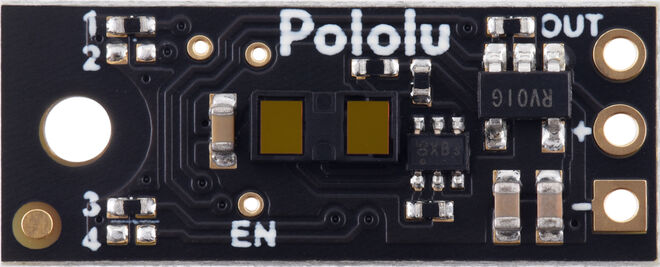
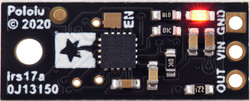
This is lidar-based distance sensor. This compact sensor makes it possible to measure the distance of objects up to about 300cm (110″). The sensor works over an input voltage range of 3.0 V to 5.5 V, and the 0.1” pin spacing makes it easy to use with standard solderless breadboards and 0.1” perfboards It uses a short-range lidar module to precisely measure how long it takes for emitted pulses of infrared, eye-safe laser light to reach the nearest object and be reflected back, allowing for 2 mm resolution. As long as the sensor is enabled, it takes continuous distance measurements and encodes the ranges as the widths of high pulses, which can then be timed by a microcontroller using a single digital input.
d=(4mm/1 µs)(t –1000 µs)
t=1000 µs+(1 µs/4 mm)⋅d
d: distance in mm
t: pulse width (in µs)
The timing uncertainty is approximately ±5%. As objects approach the sensor, the output pulse width will approach 1.0 ms
specifications
- Operating voltage: 3.0 V to 5.5 V
- Current consumption: 30 mA (typical) when enabled, 0.4 mA when disabled
- Maximum range: approximately 300 cm (110″) (for high-reflectivity targets in good ambient conditions; lower-reflectivity targets or poor ambient conditions will reduce the maximum detection range)
- Minimum range: 4 cm (for accurate measurement); < 1 mm (for detection)
- Update rate: 30 Hz to 33 Hz (33 ms to 30 ms period)
- Field of view (FOV): 15° typical; can vary with object reflectance and ambient conditions
- Output type: digital pulse width
- Dimensions: 0.85″ × 0.35″ × 0.136″ (21.6 × 8.9 × 3.5 mm)
- Weight: 0.014 oz (0.4 g)
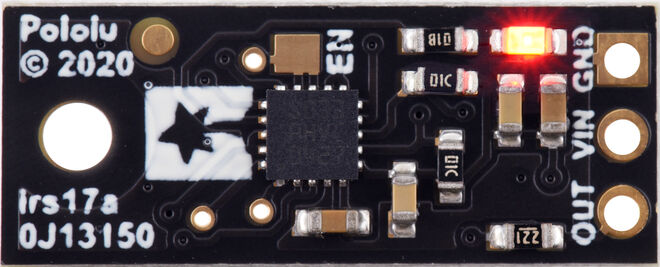
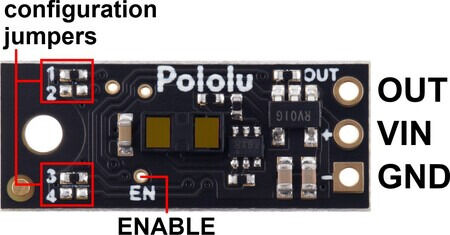
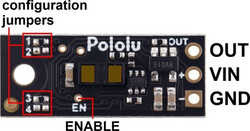
Three connections are necessary to use this module: VIN, GND, and OUT. These pins are accessible through a row of 0.1″-pitch through holes, which work with standard0.1”(2.54mm) male headers and0.1” female headers available separately). The VIN pin should be connected to a 3 V to 5.5 V source, and GND should be connected to 0 volts. The sensor outputs its digital pulses on the OUT pin. The low level of the pulses is 0 V, and the high level is VIN. A red LED on the back side of the board also lights whenever an object is detected (the closer the object, the brighter the LED).

 EN
EN